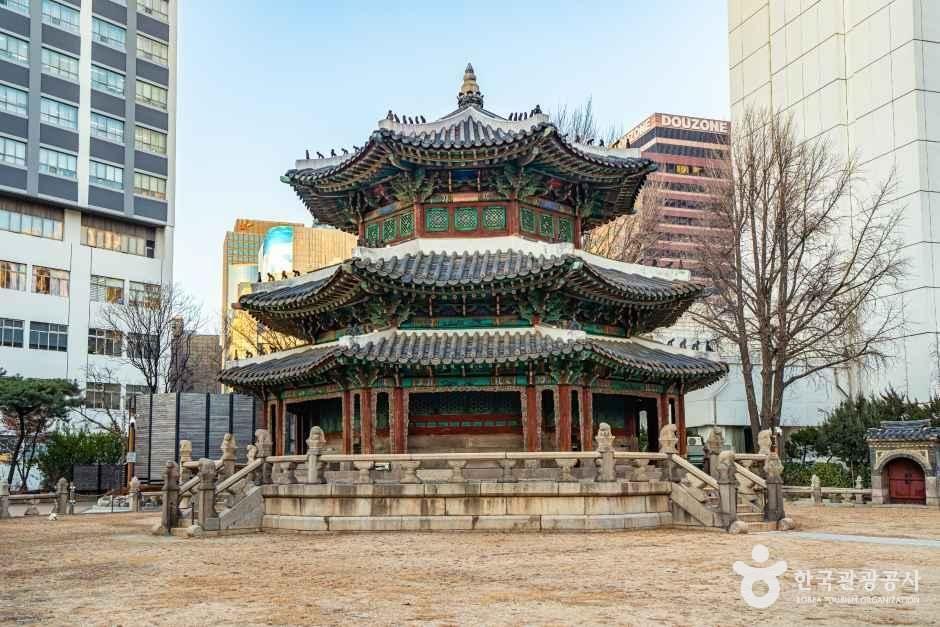
Ruins
Hwangudan
환구단
About this place
Hwangudan Altar, also called Hwandan, is a Korean Empire-era altar in Jung-gu, Seoul. Based on Confucian political ideals, it was a place where the emperor, as the Son of Heaven, performed rites to Heaven. Its Chinese-character name follows the Annals of King Gojong, while its Korean spelling follows the Independent newspaper. It was built in Gojong’s 34th year (1897) for his imperial accession ceremony and rites, on the former Nambyeolgung site opposite the then imperial palace, Gyeongungung. Originally a large sacred precinct, it included Hwangudan for ceremonies, Hwanggungu for heavenly spirit tablets, and auxiliary buildings such as Eojaesil, Hyangdaecheong and Seokgogak. Japanese colonial authorities demolished it in 1913 to build a hotel. The main altar disappeared; only the symbolic Hwanggungu and the stone drums formerly housed in Seokgogak remain. ✨AI
- Address
- 97-3 Sogong-dong, Jung-gu, Seoul ✨AI
- Korean address
- 서울 중구 소공동 97-3
- Opening hours
- ※ Please call for details ✨AI
- Closed days
- ※ 자세한 사항은 Call to confirm 요망