Attraction
Palgakjeong Pavilion
탑골공원 팔각정
About this place
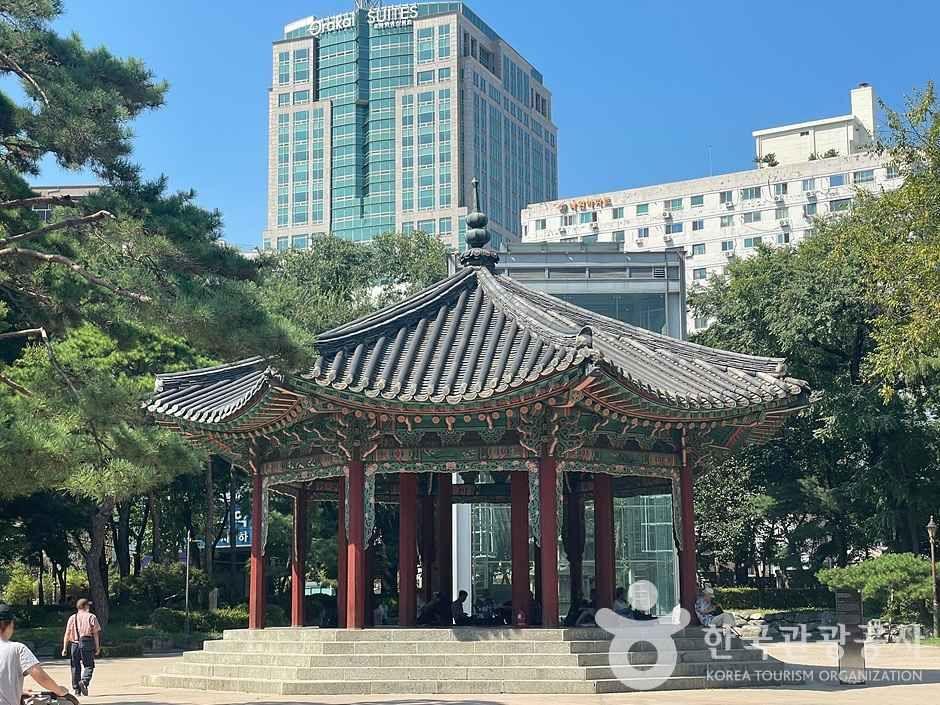
Tapgol Park Octagonal Pavilion stands in Tapgol Park in Jongno 2-ga. It was designated a Tangible Cultural Heritage of Seoul on September 19, 1989. It was built alongside the park in 1897, the 34th year of Gojong's reign, following a proposal by Brown, a British adviser to the finance ministry. Tapgol Park was Seoul's first modern park, and the pavilion is thought to have been built for military band performances at the large celebrations marking the 40th anniversary of Gojong's accession in 1902. The imperial orchestra used it as a performance venue, initially playing public concerts only on Sundays. As large numbers of citizens gathered to listen, it was opened to the public on weekdays too from July 1913. The building has an octagonal plan, with tall inner pillars and outer pillars forming the inner and outer bays and colonnades. Its octagonal roof has double eaves. Long stone blocks form a 5-tier stepped foundation around every side. Flat paving stones cover the interior floor, and the painted decoration follows the moru dancheong style. Its well-balanced exterior served as a model for the later Namsan Octagonal Pavilion. During the 3·1 Movement in 1919, students and citizens gathered in front of the pavilion to read the Declaration of Independence, shout 'Long live the Republic of Korea' and march in protest. ✨AI
- Address
- 99 Jongno, Jongno-gu, Seoul (Jongno 2-ga) ✨AI
- Korean address
- 서울특별시 종로구 종로 99 (종로2가)
- Opening hours
- - Mar~Oct 09:00~18:00 - Nov~Feb 09:00~17:00
- Closed days
- Open all year